
 21 Oct 2026
 9 min read

When comparing event management companies services, look beyond the event type on a proposal. The key question is which parts the company will own, how it will work with your team, and whether it can coordinate delivery in Poland. A clear scope can help you hand over the work without leaving gaps around decisions, suppliers or event-day staffing.
Compare event management services by scope

Event providers may offer end-to-end planning, a specialist service, production support or on-site coordination. These models can overlap, so compare the responsibilities in each proposal rather than relying on labels such as “full service”.
| Provider model | Best fit | Main strength | Key trade-off |
|---|---|---|---|
| Full-service event agency | You want one lead partner across several planning stages | A central point for coordinating workstreams | Confirm which elements are delivered directly and which involve other suppliers |
| Specialist planner | You need expertise in a particular event type or task | Focused support for a defined need | You may need to coordinate the specialist with other providers |
| Production partner | The event needs substantial technical or staging coordination | Attention to production requirements | Strategy, guest communications or other planning may sit elsewhere |
| On-site coordination team | Your plan is set but you need delivery support | Focus on schedules, people and event-day operations | It may not include earlier planning or supplier selection |
For companies for event management, a useful comparison starts with ownership: who handles the brief, venue, suppliers, guest communication, production schedule, contingency planning and event-day team? Ask each provider to mark these as included, shared or outside scope.
A broad agency may suit a launch, conference or gala with several connected workstreams. A specialist can be a better fit if you already have a plan and only need a particular capability. A coordination team may be appropriate when your internal team has completed the planning but cannot cover the event itself.
For a Poland-based event, compare both the service model and the provider’s local delivery approach. Our guide to event management companies in Poland can help you consider what to check when evaluating providers for a market-entry event.
Check how strategy connects to event goals

A proposal should show how the provider understands the purpose of the event before recommending a format. A launch designed to introduce a business locally may need a different audience, agenda and follow-up approach from an internal staff gathering or a partner dinner.
Look for a discovery process that clarifies:
- What should the event help your organisation communicate or enable?
- Who needs to attend, and what do they need from the experience?
- Which decisions are already made, and which are still open?
- What would be useful to assess afterwards, and who will review it?
The answers should shape the event concept, not just appear as background notes. For instance, if the priority is to start conversations with potential local partners, ask how the proposed format supports meaningful interaction and how guest invitations will be managed. If the purpose is to share business information, check whether the agenda and room setup support that.
Be cautious of proposals that list creative ideas without explaining their connection to your audience and objectives. Equally, a highly detailed strategy may not be necessary for a straightforward event with a settled format. The right level of planning depends on the stakes, complexity and amount of internal direction available.
If you are still deciding what kind of gathering suits the objective, our guide to business event formats in Poland can help you compare possible formats before approaching providers.
Assess planning, production and supplier coordination

Planning capability shows up in the working process. Ask to see how the company will turn the brief into a timeline, manage approvals and keep track of dependencies. You should be able to tell what happens next, who is responsible and when your team needs to make a decision.
Useful areas to compare include:
- Venue sourcing and the criteria used to shortlist options
- Supplier selection, briefing and coordination
- Technical production requirements and who manages them
- Guest registration, communications and delegate logistics
- Schedule ownership, including setup and breakdown
- Contingency planning for likely changes or disruptions
- The number and roles of people assigned to event-day delivery
The goal is not to require every provider to use the same process. It is to check whether the proposed process covers the risks and workload in your event. A business dinner may have fewer production dependencies than a conference, while a gala may require clear ownership for registration, programme transitions and on-site staffing.
Ask how changes are handled. If a menu, speaker or guest requirement shifts late in the process, who assesses the impact, updates suppliers and brings any cost or schedule change to you for approval? A good handover process should not leave an internal planner to relay every update between separate suppliers.
Also distinguish planning from delivery. A proposal may include a detailed plan but assign limited event-day coverage, or it may offer on-site coordination without taking responsibility for earlier decisions. If you need help deciding which tasks to delegate, see Event planning services for corporate events in Poland.
Verify local delivery capabilities in Poland

For an international team organising an event in Poland, local execution is more than a venue shortlist. It includes having clear communication with local suppliers, practical knowledge of the chosen location and a named team responsible for delivery on the ground.
Ask prospective providers:
- Who will be your day-to-day contact, and who will be present on site?
- Can planning meetings, documents and guest-facing communication be handled in English?
- Which local suppliers will be involved, and who manages their briefings and confirmations?
- How will venue options be assessed against your audience, access needs, programme and production plans?
- What happens if a requirement changes close to the event?
- Which decisions need your approval, and how will they be brought to you?
If your colleagues are based in more than one country, establish how information will be shared and where final decisions are recorded. Agree a single route for approvals so that changing requirements do not get lost across email threads or time zones.
Ask for a realistic explanation of the provider’s role in local coordination. Does it recommend options, negotiate or confirm details, or simply pass supplier information to your team? These distinctions matter when you are counting on a partner to reduce the amount of work your internal staff must manage.
For market-entry activity, consider whether the service needs to include guest research or event PR as well as event delivery. Those tasks may support audience planning and communications, but clarify their scope and how they connect to the event plan. If you need this kind of support, compare it as a defined workstream rather than assuming it is included in a general planning fee.
Compare fees, inclusions and decision-making responsibilities
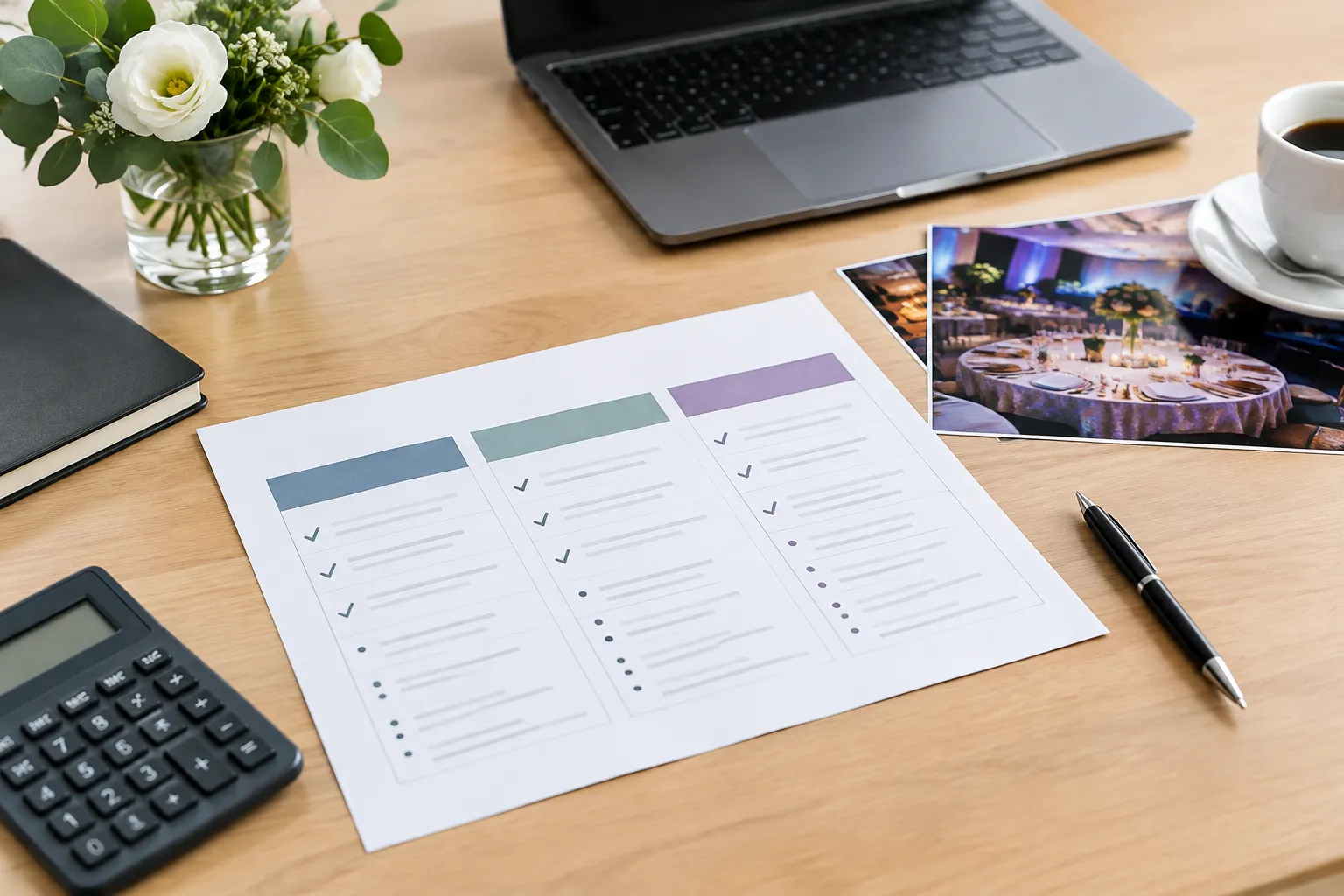
A useful proposal makes it possible to compare scope, not just the total fee. Check whether it separates the provider’s planning or coordination work from venue, supplier, production and other event costs. The format can vary; what matters is understanding what is covered and what could change.
Before choosing, clarify:
- Which services and deliverables are included?
- Which costs are estimates, and which are confirmed?
- Are supplier fees billed directly or managed through the agency?
- What is excluded, optional or dependent on a later decision?
- How are additional requests assessed and approved?
- Who can authorise changes to the brief or budget?
- What staffing is included for setup, the event itself and breakdown?
Ask for examples of likely change scenarios relevant to your event. A revised guest count, an additional speaker or a menu adjustment can affect different parts of the plan. Agree how the agency will flag consequences and request approval before proceeding, so your team knows when a decision is needed.
The cheapest-looking proposal may leave important tasks with your internal team, while a more inclusive scope may cover work you do not need. Compare the workload and risk attached to each option. If your staff cannot take on supplier coordination or event-day management, make those requirements explicit rather than expecting them to be inferred.
Put responsibilities in writing, including who owns the brief, approvals, supplier instructions, guest data and event materials. For a gala or business dinner, specify operational coverage such as registration, programme support and setup or breakdown. A clear division of work helps prevent gaps without assuming that every provider offers the same staffing model.
Choose an agency that fits your event

A practical shortlist should reflect the event you are actually planning, not a general ranking of providers. Compare each option against the same questions:
- Does the company understand the event’s purpose and audience?
- Does its scope cover the work you need to delegate?
- Is there a clear owner for planning, suppliers and event-day delivery?
- Can the team coordinate in English and work with local suppliers in Poland?
- Are fees, exclusions, change processes and client responsibilities clear?
- Does its relevant experience match the event format and complexity?
Then assess the trade-offs. A full-service arrangement can reduce the number of separate handovers, but only if the responsibilities are genuinely covered. A specialist can bring focus to one part of the project, but you may retain more coordination work. A local delivery team may be valuable for a Poland event, while your organisation still owns strategy or international approvals.
Use a short, consistent brief when requesting proposals. Include the event purpose, likely audience, city or location preferences, format, timing, known constraints, decision-makers and the work you want to hand over. Mark what is fixed and what may change. This gives companies in event management a fair basis for explaining their approach and helps you compare responses.
If you need an event to support a company’s expansion into Poland, review the agency’s approach to market entry events. For other formats, choose a provider whose stated scope matches the work: EVERITUM coordinates corporate events in Poland, including conferences, partner events, launches, galas and business dinners.
Event Agency FAQs
What does an event planning company do?
An event planning company can help define the event, organise its schedule and suppliers, coordinate guest logistics and manage delivery on the day. The exact scope varies, so confirm what the company owns and what remains with your team.
How far in advance should I book an event management company?
Book as soon as the event’s purpose, likely timing and broad requirements are clear; more complex events generally need more planning time. Availability, venue choice, supplier needs and approval timelines all affect the schedule.
Can an event agency work entirely in English with an international team?
Yes, if English-language planning and communication are within its agreed service scope. Confirm that meetings, documents, supplier coordination and guest communications are covered in English where needed.
What information should I include in an event brief?
Include the event purpose, audience, preferred dates and location, format, expected scale, budget parameters, known requirements and decision-makers. Separate confirmed details from assumptions so providers can identify open questions.
Can an event management company coordinate events across multiple cities?
Some companies can coordinate multi-city events, but the delivery model and local coverage should be confirmed for each location. Ask who manages each site, suppliers, schedules and communication between teams.
Who owns the event concept and materials after the project?
Ownership depends on the agreement and the materials involved, so define it before work begins. Ask what rights apply to concepts, designs, files, recordings and other deliverables, and how they will be handed over.
Can an agency manage both in-person and hybrid event formats?
Some agencies offer support for both formats, but hybrid delivery adds online production and audience coordination requirements. Confirm which technical, programme and attendee tasks are included for each audience.
What should I look for in an event management company’s case studies?
Look for examples with a similar event purpose, format, audience and delivery complexity. Check what the company was responsible for, which parts were handled by others and whether the example reflects the capabilities you need.
Plan your Poland event
Tell us about your event, the work you want to delegate and the questions your team needs answered. We can discuss a suitable scope for planning and coordinating it in Poland.


Agnieszka brings nearly 20 years of experience in marketing, communications and event management. At EVERITUM, she combines strategic brand thinking with practical event expertise to help international companies connect with their audiences in Poland through conferences, corporate galas and launch events. An Executive MBA graduate of WSB Merito in Poznań, she places clear communication, personal responsibility and lasting relationships at the heart of every project.